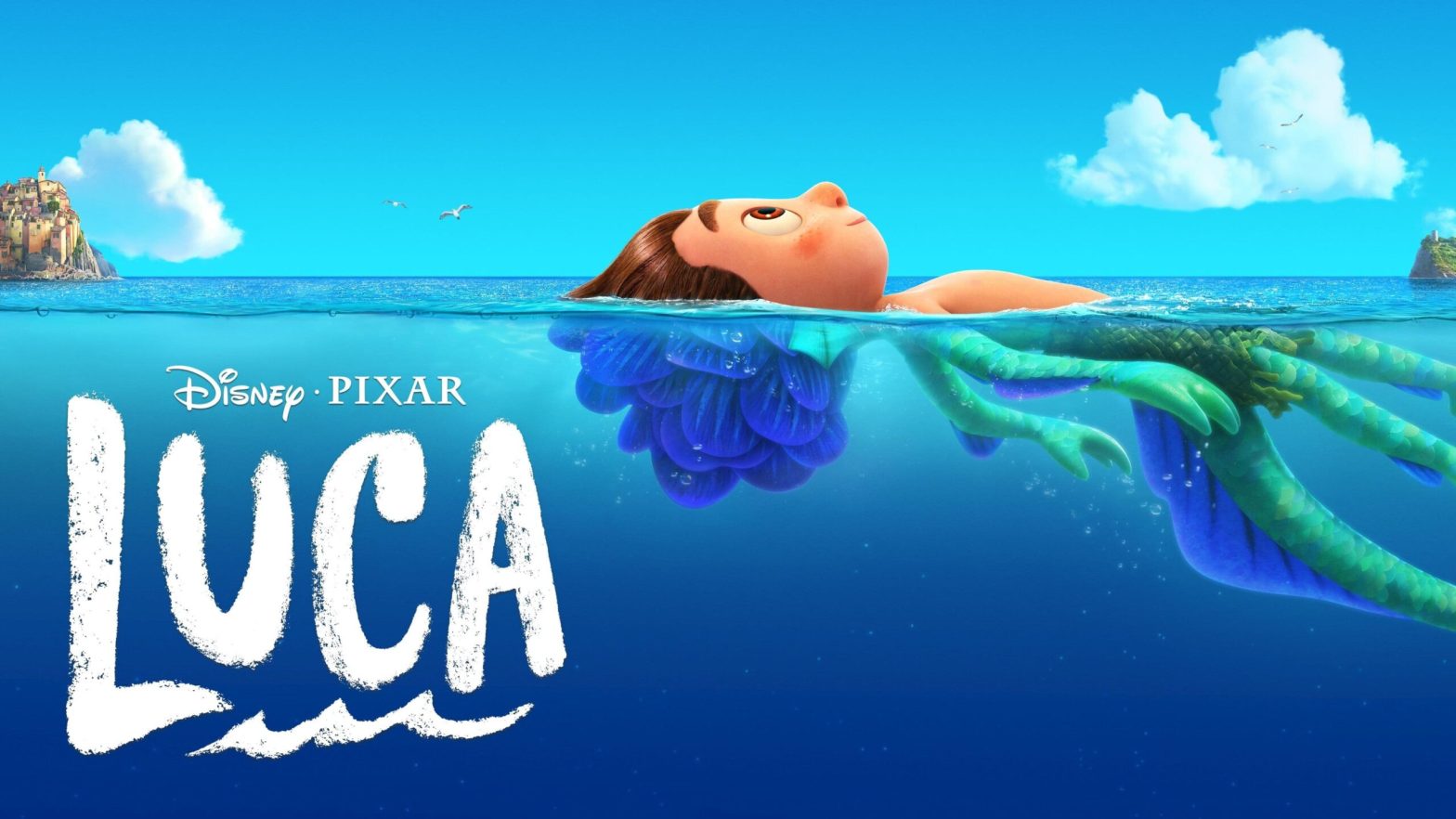
The fictional town of Portorosso, which appears in the new Pixar film Luca, is a brilliant daydream of Italy. Residents pepper their speech with ejaculations like “Santa Mozzarella!” and the youngsters compete in a triathlon of swimming, cycling, and pasta eating every year. The pastoral allure doesn’t end at the water’s edge. Sea monsters live in a lovely underwater village, herding sheeplike fish and producing rows of kelp.They stay out of the way of the “land monsters,” who have an unsettling habit of hoisting harpoons and adorning their plaza with images of fisherman fighting maritime threats. But how could anything horrible happen in such a happy-go-lucky animated world?
The instant Luca (Jacob Tremblay), the film’s young sea-monster protagonist, is hauled out onto the sand by his pal Alberto (Jack Dylan Grazer), the scene vibrates only with an unfathomable feeling of possibilities. Alberto watches, unimpressed, as Luca sputters and gasps before transforming into a human boy when the water evaporates. “Is this your first time?” Alberto inquires. “Of course!” exclaims the speaker. Luca responds with a response. “I’m a good kid!” exclaims the narrator.
When the trailer for Luca, directed by Enrico Casarosa (of the short La Luna) and written by Jesse Andrews and Mike Jones, was released, the internet immediately drew comparisons to Call Me by Your Name. Although no one expects a peach scene in a PG-rated Pixar film, Luca does seem to purposefully draw comparisons to director Luca Guadagnino’s romance, right down to a protagonist with the same first name. Luca, like Call Me by Your Name, is about two boys who embark on an intoxicatingly forbidden odyssey during a summer in Northern Italy.It also entails a lot of frolicking in shorts, riding scooters, and expressing envy when one of the two starts spending more time with Giulia (Emma Berman), the feisty local girl Alberto and Luca team up with for the big race. The fact that those boys are sea monsters who revert to their scaly shape whenever they come into contact with liquid doesn’t negate the undercurrents.
Luca is so intent on conveying a message that it only ever occupies half of the vibrantly colored universe it creates. Beyond some suggestions that there has been significantly more interaction than Luca was led to believe, we never get a fuller grasp of the past between the sea monsters and the humans. We never learn why Luca’s mother considers the world to be so scary.It’s just necessary for her to be paranoid in order for the plot to move forward, and she is. Alberto’s errant father is kept offscreen as a manner of boosting Alberto’s surrogate-parent bond with Giulia’s father, a strict but compassionate fisherman with bushy eyebrows that match his bushy beard. After Giulia shows Luca the cosmos through a telescope, Luca falls in love with astronomy.But his growing desire to learn exists in opposition to nothing in particular, because he has no idea what kind of future he would have had he stayed underwater.
One of the unintended consequences of children’s films becoming more progressive, conscious, and cautious is that they lose some of the depth they once had, when they were saturated in subtext that didn’t necessarily feel cohesive or intended. Luca collects relics from the world above, much like a particular Disney mermaid with whom he shares a corporate umbrella, but he never meets anyone quite like Ursula, a villain modeled on the drag queen Divine. Rather than Guadagnino and Hayao Miyazaki, the film would evoke Guadagnino and Hayao Miyazaki.Especially the latter’s Porco Rosso; the 1992 film is a clear reference. Luca, on the other hand, lacks the lived-in feel of a Studio Ghibli film, the tangible impression of a cosmos that extends beyond each animated frame. It does, however, contain some groovy Italian pop tunes and a setting that is as relaxing as a summer afternoon. The light glimmers off the ocean’s surface, and there’s no need to be concerned about going too deep.

